

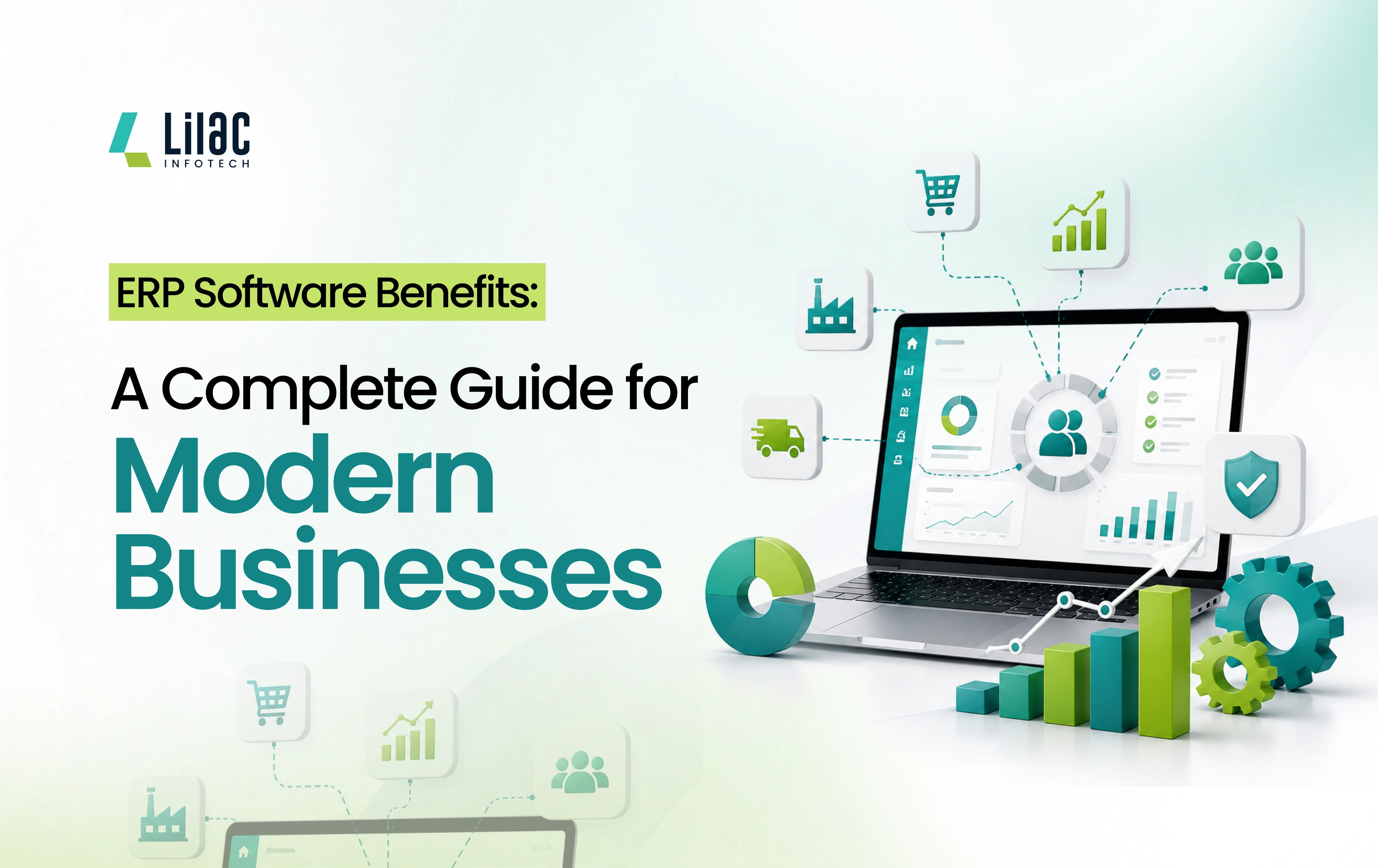
Managing a modern business involves handling multiple operations, including sales, inventory management, finance, human resources, customer service, and reporting. When these processes depend on separate tools or manual systems, businesses often face data inconsistencies, workflow delays, and limited visibility into their operations.
ERP software (Enterprise Resource Planning software)helps businesses overcome these challenges by bringing all essential operations together on a single centralized platform. It enables automation, improves collaboration between departments, provides real-time insights, and supports faster, more informed decision-making.
In this article, we will explore the key benefits of ERP software, understand how ERP systems work, discover the industries that use ERP solutions, and learn how to choose the right ERP system for your business needs.
What Exactly is ERP Software?
ERP software (Enterprise Resource Planning software) is a business management solution that integrates key operations such as finance, human resources, inventory, sales, and supply chain into one centralized platform. Instead of relying on separate applications for each department, an ERP system connects all business processes and enables smooth data sharing across teams in real time.
With ERP software, employees can access a single, reliable source of information instead of managing multiple spreadsheets, accounting systems, and inventory tools. This helps eliminate duplicate data entry, reduce operational errors, improve efficiency, and ensure that every department works with accurate and updated information.
Most ERP systems are built around modules that can be combined based on business needs, including:
- Finance and Accounting — Manages budgeting, invoicing, expense tracking, and financial reporting
- Human Resources — Handles payroll, employee records, attendance, and performance management
- Inventory Management — Tracks stock levels, warehouse locations, and reorder points
- Sales and CRM — Manages leads, customer data, orders, and sales pipelines
- Supply Chain Management — Oversees procurement, vendor management, and logistics
- Project Management — Tracks tasks, timelines, budgets, and resource allocation
- Reporting and Analytics — Generates real-time dashboards and business intelligence reports
Top ERP Software Benefits for Modern Businesses
1. Improves Business Efficiency and Productivity
One of the most immediate advantages of ERP software is an increase in operational efficiency. ERP systems automate repetitive, time-consuming processes such as data entry, invoicing, and inventory updates, allowing employees to focus on more important work.
- Automates repetitive administrative processes.
- Reduces manual errors resulting from duplicate data entry.
- Allows employees to focus on strategic, high-impact initiatives.
The result is a leaner, more productive workforce that spends less time on everyday duties and more on driving corporate success.
2. Delivers Real-Time Visibility Into the Business
Managing business information from multiple disconnected sources can make reporting slow and unreliable. ERP software solves this challenge by bringing all important data into one centralized system and keeping information updated in real time.
- Combines information from different departments into a single, accurate business view
- Provides customizable dashboards and reports based on specific business requirements
- Helps business owners and managers make decisions using the latest available data.
With real-time access to accurate information, organizations can quickly identify issues, respond to market changes, and take advantage of new opportunities without waiting for outdated reports.
3. Lowers the Cost of Running the Business
Beyond convenience, ERP software has a direct effect on overall spending. By tightening up how resources are tracked and used, businesses typically see measurable savings over time.
- Highlights areas of unnecessary spending that would otherwise go unnoticed
- Makes better use of existing staff, equipment, and materials
- Cuts down on paper-based processes and time-consuming manual work
These savings add up, which is exactly why so many growing companies turn to ERP solutions for small and medium businesses, not just large corporations with bigger budgets.
4. Strengthens Communication Across Teams
Departments that operate in isolation tend to create bottlenecks. ERP software removes that barrier by putting every team on the same platform, working from the same data.
- Links finance, sales, HR, and daily operations into one connected environment
- Cuts down on the miscommunication that happens when teams work from different information
- Makes it easier to manage workflows that span multiple departments
Once every team is pulling from the same source of truth, projects move faster and fewer things fall through the cracks.
5. Sharper Control Over Inventory and Supply Chains
For companies dealing in physical products, getting inventory right is often the difference between profit and loss. ERP systems provide an accurate, real-time picture of stock and supply chain activity.
- Monitors stock levels across every warehouse or location as it changes
- Reduces the counting mistakes that come with manual tracking methods
- Helps prevent the costly extremes of too much inventory or not enough
That kind of visibility means businesses can keep up with customer demand without locking up cash in excess stock.
6. Grows Alongside the Business
As a company expands, its systems need to keep pace. ERP platforms are designed with that kind of long-term growth in mind from the start.
- Makes it simple to bring on new users, teams, or entire business units
- Supports moving into new markets or opening new locations without a system overhaul
- Handles rising transaction volumes and more complex data without slowing down
This built-in flexibility is a big reason ERP sits at the center of most digital transformation with ERP initiatives for companies planning long-term growth.
7. Keeps Business Data Secure
Because ERP systems hold sensitive details — financial records, employee information, customer data — protecting that information is a top priority for any implementation.
- Uses role-based permissions so only authorized staff can view certain data
- Stores critical business records in a secure, controlled environment
- Lowers the risk of breaches compared to information scattered across separate tools
Keeping everything inside one well-secured platform is far safer than managing sensitive data across a patchwork of disconnected software.
8. Improves How the Business Serves Its Customers
When an ERP system includes CRM capabilities, it gives every customer-facing team a complete picture of each client relationship.
- Keeps a full record of customer orders, interactions, and communication history
- Speeds up response times when customers reach out with questions or issues
- Leads to a smoother, more consistent experience for the customer overall
When sales, support, and operations all work from the same customer data, service feels faster and more personal at every touchpoint.

Why Businesses Should Choose Custom ERP Software
Ready-Made ERP vs. Custom ERP Software
Ready-made ERP software is designed to work across a broad range of industries using standardized features. It's faster to deploy and often less expensive upfront — but it requires your business to adapt its processes to fit the software.
Custom ERP software development, on the other hand, is built specifically around your business's workflows, goals, and challenges. Instead of forcing your operations to match generic software, the system is designed to match exactly how your business runs.
Ready-Made ERP vs Custom ERP

Key Benefits of Custom ERP Software
- Business-Specific Features — Built around your exact processes rather than a generic template
- Greater Flexibility — Easily modified and expanded as your business evolves
- Easy Integration — Designed to work seamlessly with your existing tools and platforms
- Improved Workflow Automation — Automates tasks based on your specific operational logic
For businesses with unique processes or long-term growth plans, custom ERP software often delivers a higher return on investment compared to off-the-shelf alternatives.
Industries That Benefit from ERP Software
ERP software isn't limited to large corporations; businesses across nearly every industry use it to streamline operations and support growth.
- Manufacturing — Production planning, inventory control, and supply chain visibility to reduce downtime and waste
- Retail — Real-time inventory tracking, point-of-sale integration, and demand forecasting
- Healthcare — Patient record management, billing, medical supply tracking, and compliance management
- Logistics — Fleet management, route optimization, and real-time shipment tracking
- Education — Student information systems, admissions management, and administrative workflow automation
- Finance — Automated accounting, compliance tracking, and consolidated financial reporting
- Real Estate — Property management, lease tracking, and portfolio-level financial reports
- Service Businesses — Project management, resource allocation, and client billing in one platform
How to Select the Right ERP Solution for Your Business
Choosing an ERP system is a long-term investment, so it is important to evaluate your options carefully before making a decision.
- Understand Business Requirements — Map out your current workflows, challenges, and goals before evaluating software
- Check Scalability — Choose a system that can handle future growth in users, data, and transaction volume
- Consider Customization Options — Ensure the solution can be tailored to your changing needs over time.
- Evaluate Security Features — Look for role-based access, encryption, and compliance with data protection standards.
- Choose Experienced ERP Developers — Partner with a team that has proven expertise and relevant industry experience.
- Consider Long-Term Support — ERP systems require ongoing maintenance, updates, and technical support after launch
Future of ERP Software and Business Automation
ERP software continues to evolve, and businesses that adopt emerging technologies early can gain a competitive advantage.
- Cloud ERP — Offers remote accessibility, lower infrastructure costs, and easier scalability compared to traditional on-premise systems
- Artificial Intelligence in ERP — Enables demand forecasting, anomaly detection, and smarter automated decision-making
- Data Analytics — Transforms ERP systems into strategic tools for business intelligence, not just daily operations
- Mobile ERP Applications — Let managers and teams access reports and approve requests from anywhere
- Automated Business Processes — Extend automation across procurement, payroll, and other routine operations
As these capabilities continue to advance, ERP platforms are evolving from basic operational systems into centralized hubs for business strategy, analytics, and intelligent automation — making them a key component of modern business process transformation.
Frequently Asked Questions (FAQ)
1. What are the main benefits of ERP software?
ERP software centralizes business data, automates repetitive tasks, reduces manual errors, improves collaboration between departments, and gives leadership real-time insights for faster decision-making.
2. Why is ERP important for modern businesses?
Modern businesses manage complex operations across multiple departments. ERP software connects these functions into one system, eliminating data silos and helping companies operate more efficiently as they grow.
3. Can small businesses use ERP software?
Yes. ERP solutions for small and medium businesses can be scaled to include only the modules a company needs, making them accessible and cost-effective for growing businesses, not just large enterprises.
4. What is the difference between ERP and traditional software?
Traditional business software typically handles a single function, such as accounting or inventory, in isolation. ERP software integrates multiple business functions into one connected system, allowing data to flow seamlessly between departments.
5. How does ERP improve business productivity?
ERP software automates routine tasks, reduces duplicate data entry, and gives employees real-time access to accurate information — allowing teams to spend less time on administrative work and more time on high-value activities.
6. How much does custom ERP software development cost?
The cost of custom ERP software depends on factors like business size, number of modules, integrations, and overall complexity. While the upfront investment is typically higher than off-the-shelf ERP, custom solutions often deliver stronger long-term ROI since they're built specifically around business needs.
Conclusion
ERP software has become a foundational tool for businesses looking to improve efficiency, reduce operational costs, and make smarter, data-driven decisions. From automating repetitive tasks to providing real-time insights across departments, the benefits of ERP software touch nearly every part of the business — finance, operations, sales, HR, and customer service alike.
Whether you're a small business exploring your first management system or an enterprise ready to modernize outdated processes, investing in the right ERP solution can be a turning point for long-term growth. Now is the time to explore how ERP software can support your business's next stage of digital transformation.
Ready to Build Your Custom ERP System?
Looking for a powerful ERP solution for your business?Lilac Infotech provides custom ERP software development services to help businesses automate operations, improve productivity, and achieve digital transformation. Contact our experts today to build your customized ERP system.
Article Tags
Recent Posts

Why Lilac Infotech Is the Best Choice for Mobile App Development in India
Oct 22, 2026
How to Build a Grocery Delivery App Like Blinkit or Instamart
Oct 13, 2026
How to Start a Home Services Business with a Mobile App in 2026
Oct 09, 2026
Laundry Software Development Company for Smart Laundry Businesses
Oct 08, 2026






















Post a Comment